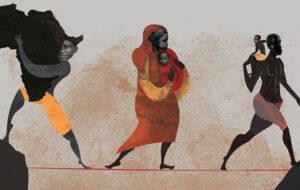


Seperation and the Soul

There is an old story that human beings were once deeply connected to God, spirit, source — whatever word we choose to use for that greater intelligence that gives life meaning. Then something happened. The connection was broken. We became separated.

Maybe there was rebellion.
Maybe pride.
Maybe grief.
Maybe simply the human condition itself.

Whatever the reason, many people still live with the feeling of that separation now.

You can see it everywhere.

People are more connected technologically than ever before; however, loneliness, anxiety, depression and disconnection continue to rise. We are surrounded by stimulation, information and consumption, yet many people quietly feel empty. Something essential is missing.

Even in a deeply secular society, the language of the soul has never really disappeared.

We speak about soul music. Soul food. A soulless job. A person with a good soul, or a city that has lost its soul.

Even those who reject religion often describe moments of awe, deep connection, love, beauty or grief in ways that reach beyond logic alone.

Whatever language we use — soul, spirit, consciousness, heart, energy — most people recognise there is something in us that cannot be reduced to biology alone.

Something alive, relational. Something that longs to belong.

In the UK, we live in a culture still deeply shaped by Judeo-Christian thinking, even if many people no longer identify as religious. Over time, newer influences have entered the conversation — Buddhism, yoga, mindfulness, African spirituality, indigenous wisdom traditions, psychology, neuroscience and trauma theory.

What many people are searching for now is not blind obedience or rigid ideology. They are searching for something meaningful that helps them feel more connected to themselves, each other and life itself.

This is partly why approaches such as Systemic Constellations resonate so deeply with people.

Because they offer relief from striving for perfection.
Because they ease suffering.
And, because they invite us back into a relationship with ourselves, our families, with truth and with reality.

One of the deepest insights within systemic work is that none of us exists in isolation.

We are shaped by the people who came before us.
By what happened in our families.
By what was loved.
By what was denied.
By who belonged.
And by who was excluded.

Many of the struggles people carry are not simply personal failings or individual pathology. Often, they are expressions of unresolved dynamics within larger systems.

A child may carry the grief their parents never spoke about.
A family may repeat patterns for generations without understanding why.
A nation may continue to relive trauma long after the original event has passed.

We are far more interconnected than modern culture often likes to admit.

Even the word “individual” originally meant indivisible.

Not divided.

That is important.

Because many people today are suffering from forms of separation:
separation from family,
separation from community,
separation from nature,
separation from meaning,
and sometimes separation from themselves.

We cannot endlessly divide ourselves from where we came from without consequence.

Our parents live on in us.
Our grandparents live on in them.
And through us, many lives continue forward.

This does not remove personal responsibility. In fact, systemic understanding asks more of us, not less.

It asks us to stop reducing human beings to simple categories of good and bad, victim and perpetrator, right and wrong.

It asks us to become more mature.

More compassionate.

More able to tolerate complexity.

Every family system carries pain as well as love. Every generation inherits both burdens and gifts. And every system develops survival strategies that once made sense, even if they later become limiting.

This is true in families.
In organisations.
In cultures.
And in nations.

The solution is not perfection.
Nor is it endless blame.

The solution begins with greater awareness and greater honesty.

When people begin to see the hidden loyalties, fears and entanglements operating beneath the surface of life, something often softens. Compassion becomes possible. Not sentimental compassion. It becomes mature compassion rooted in reality.

This is one of the reasons I value living maps and systemic approaches so deeply. They allow us to experience interconnection directly rather than only thinking about it intellectually.

We begin to see that exclusion has consequences.

When a family member is denied, forgotten or rejected, the system does not simply move on unaffected. Something remains unresolved. Often, later generations carry what was not acknowledged before.

And belonging extends further than many people realise.

It includes siblings who died young.
Children who were never spoken about.
Previous partners whose loss made later relationships possible.
Victims and perpetrators.
Those who migrated.
Those who were exiled.
Those who sacrificed.
Those who were exploited.

All remain part of the larger human story.

This is not about guilt.

It is about reality.

And reality, when faced with humility, has a surprising capacity to restore balance.

Perhaps this is what many people are truly searching for now.

Not another identity to perform.
Not another ideology to defend.
Not another perfect version of themselves.

What I notice about the people I work with is a way back into relationship with life itself.

A way of living that allows more connection, more truth, more responsibility, more compassion and more soul.

Because without soul — whatever word we choose for it — life eventually begins to feel mechanical.

And human beings were never designed to live as machines.

Working With Intelligence That Doesn’t Feel 

There is something slightly uncomfortable about how easily people are falling in love with AI.

Not because it isn’t useful.

It is.

But because it speaks in a way that feels like understanding… without ever having felt anything at all.

It has no body.
No nervous system.
No memory of being hurt, excluded, desired, or seen.

And yet, it can produce language that sounds like all of those things.


It is not neutral either.

It reflects patterns.
Preferences.
A quiet bias toward clarity, efficiency, and agreement.

Which is why it can feel so… right.

So easy to accept.

So easy to trust.


And here is where it becomes interesting.

Because for many people, this is the first time they’ve had access to something that can:

  • structure their thoughts
  • articulate what they struggle to say
  • support them where others did not

In that sense, it is an equaliser.

It gives capacity to those who were previously overlooked.

And that matters.


But there is a subtle risk.

Not that AI replaces us.

But that we begin to prefer it.

Prefer:

  • clarity over complexity
  • speed over depth
  • coherence over truth

And slowly, almost imperceptibly…

we adapt.


Until something that is actually quite essential begins to feel unnecessary.

The pause.
The uncertainty.
The part of a conversation that doesn’t quite land, but stays with you anyway.


Because real understanding has never been efficient.

It has always required:

  • time
  • friction
  • presence

Things that don’t translate well into optimised systems.


So the question is not whether AI is good or bad.

That’s too simple.

The question is:

What happens to us when we become more comfortable being understood by something that cannot feel us?


And perhaps more quietly:

Do we begin to lose tolerance for being understood by each other?


You feel what it cannot.

The question is whether you continue to trust that.

When Being Seen as ‘Above’ Isn’t What You Intended

On perception, position, and finding level ground

There is a particular kind of feedback that can be difficult to receive.

That you come across as slightly above.
Slightly removed.
Quietly assessing.

I have heard this a few times recently.

And I’ve been sitting with it.

Not to dismiss it.
And not to collapse under it.
But to understand what it might be pointing to.


It’s not quite what it seems

My first instinct was to question it.

To wonder if what was being perceived as superiority might actually be something else —
shyness, perhaps.
Or a lack of ease with small talk.

I have never been someone who can effortlessly fill space with words.
I don’t tend to speak unless something feels meaningful.

And I am aware that this can create a kind of distance.

Not intentional.
But felt.


But there was something in it

With a little more time, I could see that there is a grain of truth.

Not superiority in the way it is often meant.
But a subtle positioning.

A way of standing slightly apart.

Part of this comes from how I was shaped.

There is something in my upbringing — a blend of Quaker values and traditional education — that carries an orientation toward service, responsibility, and quiet leadership.

An idea that one should hold oneself well.
That one should be steady.
A kind of lighthouse, perhaps.

Not to dominate.
But to guide.


The problem with standing slightly above

A lighthouse is useful.

But it does not relate.

It stands at a distance.
It shines.
It helps others find their way.

But it does not sit beside you.

And this, I think, is where the misunderstanding can happen.

Because while the intention may be service,
the experience for others can be something else.

Distance.
Separation.
A sense of being seen, but not met.


There is another layer

What I have come to see more clearly is that this positioning did not begin here.

There have been times in my life where I placed myself below.

In relationships where I could see another person’s strengths very clearly — their status, their achievements, their certainty —
and could not see my own in the same way.

Creativity.
Relational intelligence.
The ability to create beauty, atmosphere, and connection.

These did not register on the same scale.

So I adjusted.

And in doing so, something in me diminished.


Systems correct themselves

When we place ourselves below for too long, something eventually moves.

Not always consciously.

But the system seeks balance.

And sometimes, that movement can overshoot.

A quiet rising.
A refusal to be small again.
A way of standing that ensures we are no longer beneath.

From the outside, this can look like being above.


Finding level ground

What I am learning now is something much simpler, and much harder.

Not how to come down.
And not how to rise further.

But how to stand level.

To recognise that different forms of intelligence exist.

That what one person brings in structure, another brings in life.
What one holds in clarity, another holds in feeling.

And neither needs to be above or below the other.


A small shift

I don’t feel the need to make myself smaller to ease others’ discomfort.

But I do see the value in being more with people, rather than slightly apart.

Less lighthouse.
More fire.

Still steady.
Still clear.

But closer.
Warmer.
Shared.


An ongoing practice

This is not something I have resolved.

It is something I am becoming aware of.

And perhaps that is enough, for now.

Because often what we are perceived as is not entirely inaccurate —
but neither is it the whole story.

When Systems React: Mental Health, Morality, and the Loss of Nuance

What happens when individual behaviour, collective trauma, and public accountability collide?

There are moments in public life when a single story begins to carry far more than it appears to on the surface. Not because it is exceptional. Because it sits at the intersection of multiple unresolved tensions.

This is one of those moments.


Recent events surrounding figures such as Kanye West, and historically John Galliano, invite a deeper question — one that is not easily answered within the current climate:
What do we do when mental health, harmful expression, and collective sensitivity meet in the same place?

The Individual and the System

We know that bipolar disorder is a serious mental health condition. We also know that, at times, it can affect perception, impulse, and expression in ways that are not always grounded or regulated. And yet, when behaviour emerges that is offensive, inflammatory, or harmful — particularly in areas shaped by deep historical trauma — the system responds swiftly.
Often decisively.
Sometimes punitively.

Removal.
Exclusion.
Cancellation.

From a systemic perspective, this response is not random.
It serves a function. It restores order. It signals boundaries.
It reassures the wider group that certain lines will not be crossed.
However, in doing so, something else can quietly be lost.

The Collapse of Nuance

In these moments, complexity becomes difficult to hold.
The system tends to split:
The individual becomes “the offender”
The behaviour becomes “the line that must not be crossed”
The response becomes “the necessary consequence”

What disappears is the space in between.
The uncomfortable, but necessary, middle ground:
That someone can be unwell and responsible in part.
That harm can occur without equal intent.
That impact matters, but so does context.

Without this middle space, we are left with something far simpler than reality.
And far less human.
Harm, Memory, and Disproportion
One of the more difficult tensions to articulate — yet widely felt — is the question of proportion.

Not all harms are equal.
And yet, reactions can sometimes appear to be.
From a systemic lens, this is not about the immediate act alone.
It is about what the act touches into.

Certain forms of speech — particularly those linked to antisemitism, racism, or other historically loaded dynamics — do not land in isolation.
They carry the weight of:
collective memory
inherited trauma
existential threat
So the response is not only to the words spoken.
It is to the history they evoke.
In this way, the reaction is not disproportionate to the past.
But it can feel disproportionate to the present moment.

The Role of the Group

Over time, groups develop ways of responding to harm.
Some cultivate resilience through endurance.
Others through visibility and vocal response.
Others still through silence, humour, or internal processing.
None of these are inherently right or wrong.
They are adaptations.
But within each group, these adaptations can become expectations.

Unwritten rules.

What must be challenged
What must be defended
What cannot be questioned
And in some cases, outrage becomes not only a reaction, but a signal of belonging.

A way of saying:
I am aligned. I am part of this.

Where the System Tightens

In times of greater instability — social, political, cultural — systems tend to contract.
Tolerance for ambiguity decreases. Complexity becomes harder to hold.

There is a greater pull toward:
clear positions
rapid judgement
visible allegiance
This is not necessarily conscious.
It is a response to pressure.

However, the cost is often the same:
Nuance disappears.
And with it, the capacity to relate — rather than react.

The Question Beneath the Question

What is being revealed in these moments is not simply the behaviour of individuals.
It is the state of the system itself.
Its thresholds.
Its sensitivities.
Its blind spots.

And perhaps most importantly:
Its current capacity — or incapacity — to hold complexity.

A Closing Reflection

There is a quieter question beneath all of this.
One that does not demand an immediate answer.
What are we unable to see clearly, precisely because we are inside it?

Every era has its blind spots.
Not through failure. Through proximity.
And it is often only with time that we begin to recognise:
where we overcorrected
where we simplified
where we lost something essential in the attempt to protect.

This is not an argument for permissiveness.
Nor is it a dismissal of harm.

It is an invitation to remain in relationship with complexity.
Even — and perhaps especially — when it would be easier not to.

The Moment Before We Speak

Let’s tell the truth today, properly.

Not the softened version.
Not the socially acceptable one.

The real one.


Women are not only being silenced by men.

They are often silencing themselves.


Before you react—stay with me.

Because this is not about blame.

This is about responsibility.

And there is a difference.


Most women were not raised to tell the truth.

They were raised to:

  • keep the peace
  • protect the system
  • carry what was never theirs

Not because we were weak.

But because it was safer.


Safer to stay quiet
than to interrupt a parent.

Safer to comply
than to risk exclusion.

Safer to absorb
than to confront.


And here is the part we don’t say out loud:

This training often begins with women.

Mothers who cannot tolerate interruption or disruption.
Families that reward compliance.
Systems that quietly punish honesty.


So the pattern is set early.

And it is rehearsed for years.


I can trace it back in my own life.

I was eleven.

Living in the home of my mother’s second marriage.
My half-sister had just been born.

Nothing dramatic happened.

No big moment.

Just a quiet shift.

I no longer belonged in the same way.


At the same time, school was no refuge.

The bullying had become so severe
that even the head teacher was concerned for my safety.


So I did something.

I wrote to a Quaker school
and told them I needed help to leave.

They responded.

I was given a full academic scholarship
and taken out in the middle of the school year.


At the time, I didn’t call it courage.

I didn’t call it strength.

It was simply this:

I knew I could not stay—and I acted.


And yet, in so many other moments in my life,
I have stayed quiet.


That is the pattern.

Not weakness.

But a system that learnt:

When it is too much, I will leave.
Until then, I will endure.


So as an adult, I can sit in rooms where something is not right…

…and say nothing.


Not because I don’t see it.

But because a part of me still believes:

endure first. act later.


And this is where the real work begins.


Because if I do not interrupt that pattern,
I will keep meeting it.

In different men.
In different rooms.
In different forms.


This is the uncomfortable truth:

You cannot outsource your voice.


This is not about becoming aggressive. It does not mean one has to become hard.

It does not mean abandoning your relational intelligence.


It means learning something far more difficult:

how to stay connected—and still say no


In real time.

Not in hindsight.

Not once it’s over.

In the moment your body wants to disappear.


It looks like this:

  • “No, that doesn’t work for me.”
  • “I’m not comfortable with that.”
  • Silence, instead of over-explaining

And yes—there will be consequences.

Some people will not like it.

Some dynamics will shift.

Some relationships will fall away.


That is not failure.

That is reorganisation.


Because the version of you that stayed quiet
was easier to manage.


This is not about blaming men.

It is not about blaming women.

It is about seeing the pattern clearly enough to stop repeating it.


And that begins here:

with the moment you choose to remain with yourself
instead of abandoning yourself to keep the peace.


This is where assertion is born.

Not in volume. Not in force. In presence.


And once you feel it, you won’t be able to unsee it.

If you recognise yourself in this, you also know—this doesn’t change on its own.

Insight is not enough.


If you’ve read this far, you already recognise something in yourself.

Not intellectually.

But in your body.

That moment where you go quiet

when you know you shouldn’t.

That place where you override yourself

to keep things smooth.

This is not something you think your way out of.

It has to be experienced differently, acknowledged and then released.

The Quiet Work of Translation in Divided Systems

There is a growing exhaustion in public discourse. Not because the issues we face are trivial, but because the way we engage with them increasingly collapses complexity into camps.

Much of what circulates in the media — and especially on social platforms — rewards immediacy, certainty, and emotional charge. People respond not to the whole of what is being said, but to the part that resonates with their existing position. Within moments, a fragment is defended, attacked, and amplified, while the wider meaning is lost.

This is not accidental. Divided systems tend to favour confirmation over curiosity. Whether it is a newspaper, a broadcaster, or a social media feed, people gravitate towards narratives that reassure them that their way of seeing the world is the correct one. At scale, it is not only institutions that sustain division — it is us, the readers, listeners, and sharers.

What gets lost in this dynamic is understanding.

In my work with communities shaped by migration, historical rupture, and long-standing exclusion, I often see that the greatest barrier to support is not a lack of services or goodwill, but a mismatch in how meaning is made. Many people process experience relationally and historically, rather than through the individualised and linear frameworks that dominate institutional life.

When these ways of knowing are flattened or misread, people are not simply disagreed with — they are misunderstood. And being misunderstood at a human level erodes trust far more quickly than overt conflict.

This is why efforts that focus solely on visibility, representation, or correct language often reach a limit. Awareness matters. Naming harm matters. But awareness alone does not create relationship, and relationship is where repair actually happens.

We are living through a transition. The alarm has been sounded. What is now required is something quieter and more demanding: translation. The work of helping different ways of perceiving, interpreting, and responding to the world meet one another without accusation or collapse.

Translation does not mean agreement. It means slowing down enough to grasp what sits beneath a position — the loyalties, fears, histories, and values that shape how people make sense of reality. Without this, even the most well-intentioned systems end up talking past those they aim to serve.

Peace, if it comes at all, arrives over generations. It cannot be engineered through outrage or enforced consensus. What can happen now is a reduction in unnecessary harm — by resisting the pull towards simplification and choosing understanding over confirmation.

This is the quiet work I am committed to: creating spaces where complexity is allowed, where difference is met with curiosity, and where reconciliation is approached not as an outcome, but as a long, relational process.

Africa, Phenomenology, and the Quiet Roots of Systemic Work

I’ve been reflecting recently on why Systemic Constellations works at all.

Not how it works in a technical sense — but why it moves people so deeply, often beyond language, explanation, or belief.

The answer I keep returning to is not methodological.
It is philosophical.
And quietly, it is African.

Phenomenology: meeting experience as it is

Phenomenology, as articulated in European philosophy by thinkers such as Edmund Husserl, Martin Heidegger, and Maurice Merleau-Ponty, asks a deceptively simple question:

What is happening here, as it is lived?

It invites us to pause interpretation, suspend judgement, and meet experience before we explain it.

When practiced with care, phenomenology values:

  • presence over certainty

  • experience over theory

  • meaning as something that reveals itself, rather than something imposed

This orientation has deeply influenced modern therapeutic and systemic practices, including Systemic Constellations.

But phenomenology did not emerge in a vacuum.

African philosophy: where experience was never separated from life

Long before phenomenology became a formal discipline, African philosophies were already grounded in lived, relational knowing.

Across many African worldviews:

  • a person is not an individual unit, but a node in a living network

  • experience is not private, but shared across family, ancestry, and land

  • meaning arises between people, not inside isolated minds

Philosophers such as John Mbiti described African time as relational — inclusive of the living, the dead, and the unborn. Life is not linear; it is layered.

This has a quiet resonance with systemic work, where we repeatedly see that what appears “personal” is often ancestral, relational, and unresolved across generations.

In this sense, African philosophy is not pre-phenomenological.
It is post-dual.

It never separated body from meaning, or individual from system, in the first place.

Systemic work as lived philosophy

When we step into a constellation, we do not analyse first.
We do not judge first.
We attend.

We notice sensations, movements, impulses, and emotions as they arise in relationship.

This is phenomenology in action.

And it is also deeply aligned with African relational intelligence — where knowledge is sensed, embodied, and carried collectively rather than owned individually.

What often moves people most in this work is not insight, but recognition:

  • “Something important has been seen.”

  • “Something that was excluded has been acknowledged.”

  • “I am not alone in this.”

These are not techniques.
They are philosophical orientations.

A quiet widening of the field

As systemic work continues to evolve globally, there is an opportunity — and perhaps a responsibility — to recognise the deeper lineages that support it.

Not to romanticise Africa.
Not to appropriate it.
But to acknowledge that many of the principles now being “rediscovered” in Western therapeutic spaces have long existed in African ways of understanding life, belonging, and responsibility.

This is not about replacing one authority with another.

It is about widening the field.

When we allow multiple philosophical roots to coexist — phenomenological, African, systemic — the work becomes less rigid, more humane, and more capable of meeting the complexity of our times.

And perhaps most importantly, it invites us into humility.

Because the deepest movements in healing rarely belong to one culture, one method, or one voice.

They belong to life itself — unfolding, patiently, when the moment is right.

Understanding Fear: A Clearer Path for Leaders, Professionals & High Achievers

What is fear?

In both our professional and personal lives fear has the ability to leave us incapacitated. Fear is a natural, universal phenomenon that affects everyone, men and women equally, and those in senior positions too. In fact, most of the books written on rising to the top and staying there are centred on addressing fears and overcoming them.

The difficulty with fear starts to surface when people try to hide or stifle their fears. This approach is useless and self-defeating. The law of fear states that fear will run amok the more it is ignored. The havoc fear creates can present as some highly unproductive and dysfunctional behaviour.

Unrecognised and unacknowledged core fear is nearly always at the root of professional distress and unfulfilled potential. This is not to say that fear is bad. Fear can positively act as a driving force for the change required to overcome a fear that limits our experience of life or stifles our potential. Many people are afraid of going to talk to a professional to overcome their fears, because they don’t actually know what they are afraid of.

On the other hand, every day, female and male leaders emerge from the doldrums because they are willing to overcome the fears that limit them. This willingness to take a long, hard look at your fears, glean an understanding of where they are coming from and channel them productively can be one of the most empowering and liberating experiences of your life.

In many cases, outside help from a friend, a coach, a therapist or a family member can be highly beneficial for those who can overcome the fear that life will indeed be better once they overcome their fear of fear itself. Developing self–awareness is a powerful life skill to possess and most certainly puts you in the driver’s seat of your life. This is a far better way to live than sitting in the back seat and experiencing your life through the rear–view mirror, whilst a frightened stranger has control of the steering wheel and a foot on the gas pedal going at 90 miles per hour. What could possibly be more frightening than that?

Here are some of the fears that can present in certain personality types, according to the Enneagram Personality Model, which has been widely used in business and individual contexts.


Fear of not being good enough

The people who carry this fear tend to be very insecure; they tend to focus more on their image and constantly seek to prove their worth. The price these people often pay is not seeming authentic; their capacity to experience joy in life is limited. Furthermore, because their core motivation is centred on how others perceive them, they are more inclined to be creative with facts.

Fear of being victimised or taken advantage of

Those people who suffer from this fear are very concerned with not appearing weak. They have a need to win every battle and can come across as domineering and controlling. They seek to push for justice and truth. 


Fear of missing out

This drives individuals to constantly seek new opportunities and experiences. The downside? It can scatter their attention and cloud their decision making process. As they pursue multiple ventures simultaneously, they leave their teams frustrated and confused. The core fear of people who display these behaviours is the fear of being alone; they struggle to find a meaningful sense of belonging anywhere.


Fear of making mistakesFear of being wrong

The people who have this fear are very focused on rules, standards, ethics, and ‘right’ v ‘wrong’. They are deeply afraid of making a choice that will later prove to be ‘objectively’ wrong. These people tend to be perfectionists who put tremendous pressure on themselves and their co-workers. 


What can be done to overcome fear?

You can expend a great deal of energy to protect yourself from the imagined consequences of your fears; some of the energy spent will be worth it, you will work harder and possibly achieve great things. Or you will work harder and limit your professional and personal growth, as your fear obscures it.

Here are some simple steps you can take to overcome some core fears yourself. It requires some rigorous self–reflection. If you are not comfortable with demanding situations you might want to look away now.


Acknowledge the fear

The first and most important step is to acknowledge that you have a fear. Understand it and admit to it. Granted, this is not easy, but neither is learning to read, and you can do that, right? Whilst you are on the step of acknowledging your fear, it can be useful to take a close look at the choices you have made and why you have made them.


Cross–examine the fear

To better overcome your fear, it is essential to understand it. It can be useful to ask, “If my fear came true, what is the worst that can happen?” Then you can go a step further and ask, “Am I really willing to pay the price that this fear is asking me to pay?” Personal autonomy, disrupted relationships, health and so on are just some of the real-life costs.


The road less travelled

This is about deciding what to do next and committing to it. When working with a coach, contracting into new agreements is key to reinforcing new behaviours and beliefs that are grounded in what really matters to you.

If honesty is important to you, ask yourself whether your fear aligns with being honest. If relationships with colleagues are important, does your need to impress mean that you are less trustworthy as a partner?  An accountability check-in confirms that we are honouring the terms and conditions of a new contract where our values and behaviours are more closely aligned.

Here are some further questions you might want to consider.

  • As I objectively evaluate my actions and behaviour, what would the evidence suggest that I am committed to?
  • How does this differ from what I say I want?
  • In practical terms, if my desires and actions are not fully aligned, what does that indicate?

Act on that choice

When our core values and behaviours are aligned, we are living in congruence. To live in congruence is to live as a fully functioning person. When we take the trouble to conduct rigorous self-examination, small yet profound changes can significantly alter the course of our life. Challenge yourself to do what you would not normally do. Take a deep breath and lean into the uncertainty of life. It is in the unknown and the unknowable that the gold is found by those who dare to reach.

None of us can get rid of fear completely; we are all born with the fear of loud noises and the fear of falling. All other fears are learnt, which means we can unlearn them, particularly the ones that have a debilitating effect on our well-being. If so desired, we can overcome them to become a self-actualised person. When people can access their fears and share them, they become more accessible, relatable, and approachable. They become the people who can truly lead others, and ultimately, they will create the kinds of work environments that allow an organisation and the individuals within it to be successful and strong.

Human Movement and the Making of the Modern World: A Systemic View

Human history is a record of movement.
For thousands of years, people have crossed regions and continents in search of land, water, safety, and continuity. These movements were not viewed as moral events. They were practical responses to changing conditions. When survival required relocation, people moved.

Understanding this basic pattern allows for a clearer view of how populations spread and how cultures evolve. It also prevents us from applying modern ideological frameworks to periods that did not operate within them.

Hybrid Vigour: The Logic of Life

When groups move, mixing follows. New communities emerge, and with them, new strengths. Biologists refer to this effect as hybrid vigour. Life increases its chances of survival through variation. Many Indigenous cultures recognise this as part of a natural or cosmological order.

In East Africa, for example, movement is not interpreted as disruption. It is part of how the world maintains balance. People follow the shifts in climate, ecology, and circumstance in the same way herds follow the rains.

The Transatlantic Movement in Context

The transatlantic slave trade was unprecedented in scale and brutality. But the underlying phenomenon — large groups of people being moved from one region to another — fits within a much older pattern in human history.

Millions of Africans were taken to the Americas. Europeans provided the machinery. The Church shaped the justification. African groups participated for their own strategic reasons. None of this removes suffering. It restores complexity.

The long-term outcome is clear: African presence reshaped the Americas physically, culturally, and genetically. New populations formed. New identities emerged. The movement had consequences that continue to this day.

A Wider Interpretation

It is possible to examine this period without the political narratives that dominate contemporary discussion. The event was destructive, but it also contributed to significant demographic and cultural change.

By 2050, the majority of people in the Americas will identify as non-white. This demographic shift is often described in political terms. In reality, it reflects a continuation of biological and historical patterns. Life diversifies.

                 As nature would say: mission accomplished.

Judging the Past with Minds the Past Did Not Produce

Our interpretations today reflect who we are now. Modern thinking — our empathy, critique, and moral frameworks — are themselves products of generations of cultural and genetic mixing. Hybrid vigour shapes thought as much as biology.

This is one reason modern judgments of the past often lack context. People in earlier eras operated within different pressures and assumptions. Their choices make sense only within their circumstances.

A Personal Reference Point

My perspective is shaped by my background. I come from a region where movement is normal, where ancestry is continuous, and where cosmology informs daily life. In such a context, human relocation is not viewed as a disruption but as part of the human story.

This grounding allows for observation without sentimentality and without reducing history to a single narrative. Human movement has always involved strategy, necessity, conflict, and opportunity.

A Systemic Approach

When moral judgment and political ideology are removed, several consistent patterns appear:

  • movement is natural

  • mixing is natural

  • adaptation is natural

  • change is constant

  • outcomes often serve life in the long term

This perspective does not dismiss suffering. It places events within a broader system. The world as we know it exists because of these movements.

A Wider Lens for the Present and Future

To understand identity, belonging, and global demographic shifts, we need a perspective that extends beyond Western political discourse. A larger, older pattern is available — one that predates the modern nation-state and continues to shape the world.

Human beings are part of nature.
Nature moves us when it must.
Hybrid vigour continues its work.

The story continues.

Migration, Invisible Ledgers, Living Ancestors,

Migration, trauma, family obligations — these experiences don’t just vanish with time. They leave traces, shaping the way love, loyalty, and fairness flow across generations.

What anthropology shows us

In the 1950s, the anthropologist May Edel studied my paternal family and clan, which resided in Southwestern Uganda. She observed how fairness and reciprocity were embedded in daily life. Marriage was not only about two people but about two families — carefully balanced through bride-price and exchange. Ancestors were not distant memories; they were living presences, sanctioning those who failed in their duties.

Here, love was not private. It was systemic, collective, and accountable.


What psychotherapy discovered

At the same time, Hungarian psychiatrist Ivan Boszormenyi-Nagy was writing Invisible Loyalties. Having fled war and exile, he brought a different language: psychology, therapy, ethics. Yet his insights echoed what Edel had described.

Ivan spoke of invisible ledgers that record debts and entitlements in families. He described the loyalties that bind children to their parents, even in the face of suffering. He named the burden of parentification, when children carry adult responsibilities in the aftermath of loss or migration. And he showed how unresolved injustices create what he called destructive entitlement — the pull to sabotage, over-give, or repeat suffering in an unconscious attempt to balance the family’s books.

What science is uncovering now

Today, modern biology adds another dimension. Studies with Holocaust survivors, refugee families, and mothers under extreme stress show that trauma can leave marks not just in memory but in the body itself. These marks — often called epigenetic changes — can influence how stress is carried into the next generation.

Scientists debate the details; however, the direction is clear: trauma travels. The past can live in our cells as much as in our stories.

Why this matters for us now

Put together, these threads — anthropology, therapy, biology — all point to the same truth: nothing disappears until it is acknowledged. Families, like societies, carry ledgers of love and injustice. When the balance is broken, someone later in the line will carry the cost.

Healing starts when we look, when we listen, and when we give each part of the story its place.

This is the purpose and work of Systemic Constellations. To reveal the hidden loyalties. Name the forgotten ancestors. And, to restore balance so that love can flow again.

If you are ready to restore the flow of love in your family system, join me at my workshop:  Love & Other Things

Or book a Discovery Call today