

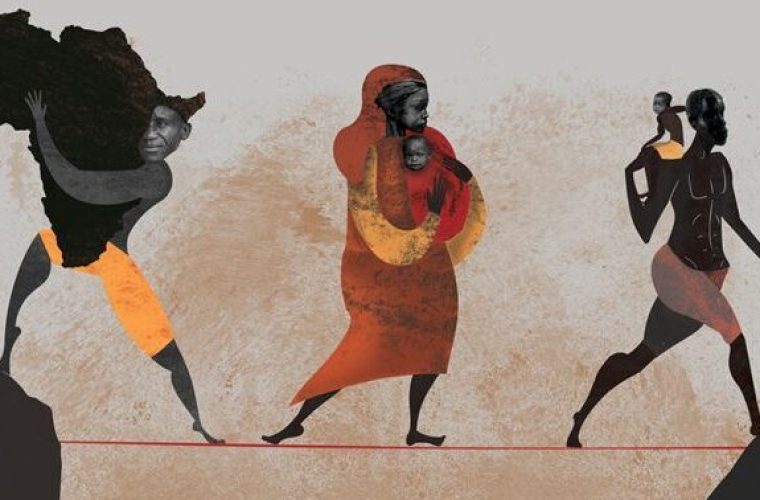
Human history is a record of movement.
For thousands of years, people have crossed regions and continents in search of land, water, safety, and continuity. These movements were not viewed as moral events. They were practical responses to changing conditions. When survival required relocation, people moved.
Understanding this basic pattern allows for a clearer view of how populations spread and how cultures evolve. It also prevents us from applying modern ideological frameworks to periods that did not operate within them.
Hybrid Vigour: The Logic of Life
When groups move, mixing follows. New communities emerge, and with them, new strengths. Biologists refer to this effect as hybrid vigour. Life increases its chances of survival through variation. Many Indigenous cultures recognise this as part of a natural or cosmological order.
In East Africa, for example, movement is not interpreted as disruption. It is part of how the world maintains balance. People follow the shifts in climate, ecology, and circumstance in the same way herds follow the rains.
The Transatlantic Movement in Context
The transatlantic slave trade was unprecedented in scale and brutality. But the underlying phenomenon — large groups of people being moved from one region to another — fits within a much older pattern in human history.
Millions of Africans were taken to the Americas. Europeans provided the machinery. The Church shaped the justification. African groups participated for their own strategic reasons. None of this removes suffering. It restores complexity.
The long-term outcome is clear: African presence reshaped the Americas physically, culturally, and genetically. New populations formed. New identities emerged. The movement had consequences that continue to this day.
A Wider Interpretation
It is possible to examine this period without the political narratives that dominate contemporary discussion. The event was destructive, but it also contributed to significant demographic and cultural change.
By 2050, the majority of people in the Americas will identify as non-white. This demographic shift is often described in political terms. In reality, it reflects a continuation of biological and historical patterns. Life diversifies.
As nature would say: mission accomplished.
Judging the Past with Minds the Past Did Not Produce
Our interpretations today reflect who we are now. Modern thinking — our empathy, critique, and moral frameworks — are themselves products of generations of cultural and genetic mixing. Hybrid vigour shapes thought as much as biology.
This is one reason modern judgments of the past often lack context. People in earlier eras operated within different pressures and assumptions. Their choices make sense only within their circumstances.
A Personal Reference Point
My perspective is shaped by my background. I come from a region where movement is normal, where ancestry is continuous, and where cosmology informs daily life. In such a context, human relocation is not viewed as a disruption but as part of the human story.
This grounding allows for observation without sentimentality and without reducing history to a single narrative. Human movement has always involved strategy, necessity, conflict, and opportunity.
A Systemic Approach
When moral judgment and political ideology are removed, several consistent patterns appear:
-
movement is natural
-
mixing is natural
-
adaptation is natural
-
change is constant
-
outcomes often serve life in the long term
This perspective does not dismiss suffering. It places events within a broader system. The world as we know it exists because of these movements.
A Wider Lens for the Present and Future
To understand identity, belonging, and global demographic shifts, we need a perspective that extends beyond Western political discourse. A larger, older pattern is available — one that predates the modern nation-state and continues to shape the world.
Human beings are part of nature.
Nature moves us when it must.
Hybrid vigour continues its work.
The story continues.